
Water becomes destructive when it occupies spaces that need air-filled voids, stable contact stresses, and predictable material behavior. In transport infrastructure, even a modest loss of drainage capacity can raise pore-water pressure, weaken unbound layers, soften pavement support, trigger erosion, or impose hydrostatic loads on retaining and underground structures. Drainage is therefore a managed route for water, not merely a collection of pipes and ditches.
Water movement governs drainage performance
Drainage design starts with a water balance: where water comes from, how quickly it enters the ground or structure, where it may be stored temporarily, and how it can leave without causing damage. Key sources include rainfall runoff, snowmelt, groundwater, seepage from adjacent slopes, irrigation leakage, and flows concentrated by upstream catchments.
Within soil, water movement is commonly described by Darcy's law. Under saturated conditions, flow rate depends on hydraulic conductivity, flow area, and hydraulic gradient. Clean coarse gravel can transmit water readily, whereas fine-grained soil may do so slowly even when saturated. This distinction is important: a drain installed in low-permeability ground may collect little water unless surrounding layers, filters, or drainage blankets provide a workable flow path.
Unsaturated flow also matters near pavements, embankments, and slopes. Capillary forces can draw water upward through fine pores, while repeated wetting and drying alter suction and effective stress. A system that manages surface runoff but overlooks perched water or capillary rise may leave the subgrade persistently vulnerable.
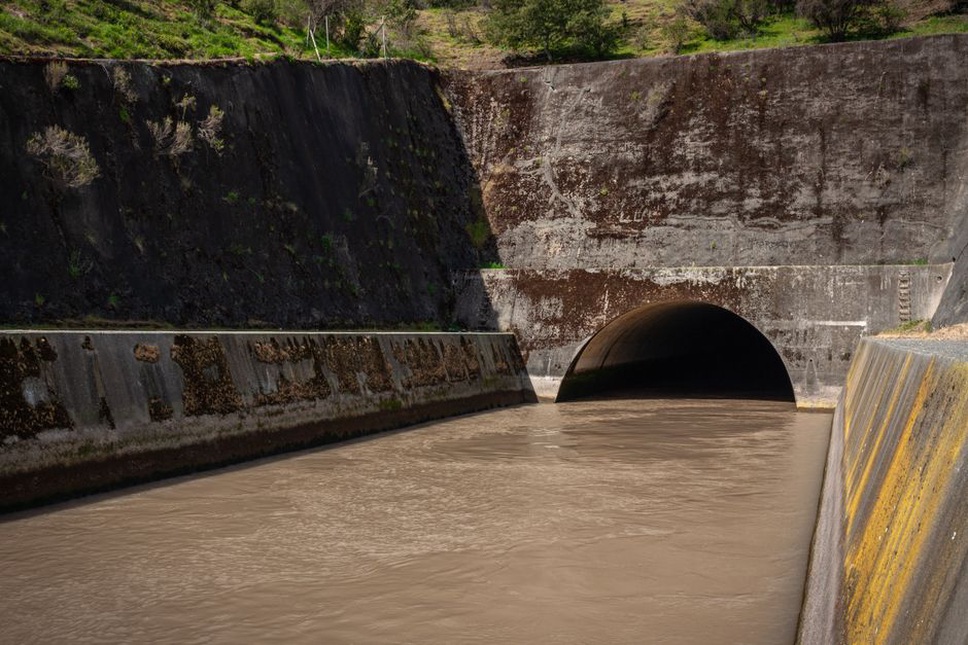
Drainage acts on three connected domains
Reliable drainage manages water at the surface, within the ground, and at the outlet. A weakness in any one of these areas can compromise the whole system.
Surface collection and conveyance
Surface drainage limits infiltration and prevents water from concentrating where ponding or erosion can develop. Crossfall, longitudinal grade, gutters, channels, swales, inlets, catch basins, and culverts collect and convey runoff. Their hydraulic capacity must be assessed alongside sediment transport, debris blockage, ice, vegetation growth, and the likely consequences if flow exceeds its intended route.
The governing condition is often a short, intense storm rather than average rainfall. Runoff increases when rainfall intensity exceeds infiltration and available surface storage. Impervious pavements speed this response, while cut slopes and concentrated discharge points can generate high local velocities. Outlet protection can be as important as the channel itself, since uncontrolled discharge may scour soil, undercut a pavement edge, or destabilize an embankment toe.
Subsurface interception and pressure relief
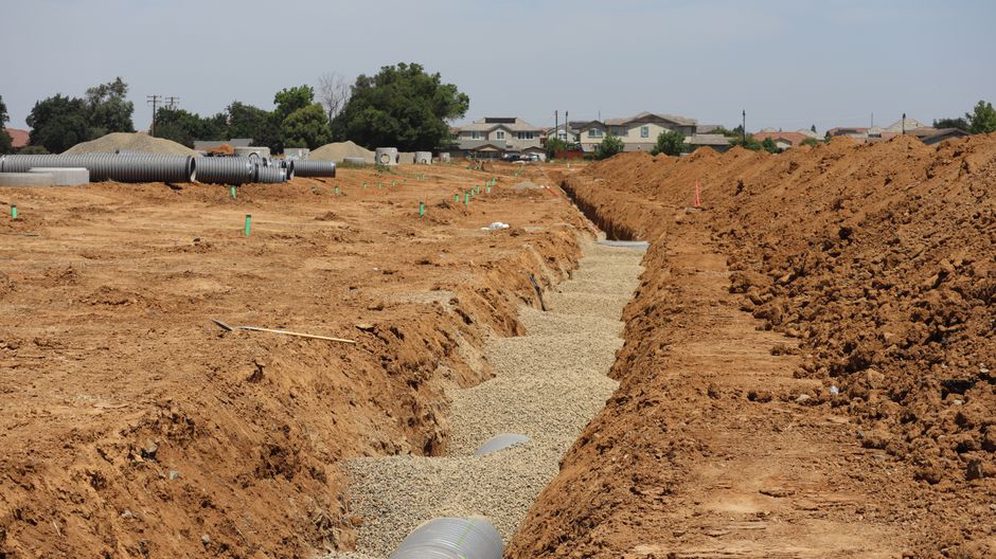
Subsurface measures control water levels before they affect the structure. Typical elements include edge drains, longitudinal collector drains, trench drains, drainage blankets, granular filters, drainage galleries, and, in specialized settings, relief wells. Their roles are different:
- Interception drains capture seepage before it reaches a slope, formation layer, or excavation.
- Collector drains receive flow from permeable layers and convey it to a controlled outlet.
- Drainage blankets distribute flow over a broad area and shorten the distance water must travel through low-permeability material.
- Pressure-relief systems reduce pore-water pressure, increasing effective stress and soil shear strength.
A pipe by itself is not necessarily a drainage system. It requires adequate surrounding permeability, an appropriate filter or separator, sufficient gradient where gravity flow is intended, accessible cleanouts where practical, and an outlet that continues to function during flood conditions.
Outlets are the system's controlling boundary
Every drainage route ends at an outlet, and outlet condition often determines long-term performance. A collector with ample capacity can still fail if its outfall is submerged, blocked, eroded, backfilled, or damaged during maintenance. Backwater reduces hydraulic gradient and may prevent drainage during the events when pressure relief is most needed.
Outfalls require assessment of receiving-water levels, erosion resistance, environmental constraints, inspection access, and safe discharge routes. Where gravity discharge cannot be relied upon, storage, pumping, staged outlets, or other project-specific measures may be required following a full hydraulic and geotechnical assessment.
Why drainage changes structural behavior
In saturated soil, total stress is shared by the soil skeleton and pore water. Effective stress is commonly expressed as total stress minus pore-water pressure. When water pressure rises while total loading remains unchanged, effective stress falls. In many soils, this reduces both shear strength and stiffness.
This is why drainage is fundamental to slope reliability, foundation performance, and earthworks. A wet embankment may deform more than expected. A cut slope may develop shallow slips after prolonged rainfall. A pavement foundation may lose resilient support during thaw or repeated infiltration. Water can also drive internal erosion by carrying fine particles through vulnerable zones and gradually creating voids, sinkholes, or localized settlement.
For paved roads and rail corridors, drainage affects the whole material system, not just the wearing surface. Repeated wheel loads on a saturated granular layer can cause particle rearrangement, pumping of fines, and permanent deformation. In frost-susceptible soils, available water is one condition required for ice-lens growth. Keeping water away from the formation can reduce seasonal heave and thaw weakening, although frost behavior also depends on temperature, soil type, and heat-transfer conditions.
Drainage-related distress should be separated from defects caused mainly by inadequate structural thickness, material degradation, or loading. Road surface monitoring methods, data quality, and maintenance decisions can help identify recurring wet areas, edge deterioration, rutting patterns, and defects that warrant a drainage investigation rather than a surface-only repair.
Filters and geotextiles prevent hidden failures
Where water flows from fine soil into a coarse drainage layer, the interface must pass water without permitting damaging migration of soil particles. That is the purpose of a properly selected filter. A granular filter may be graded to retain the protected soil while remaining more permeable than that soil. A geotextile can provide separation and filtration when its opening characteristics, permeability, survivability, and resistance to clogging suit the ground conditions.
Filter design cannot be based on a generic fabric choice. Fine soils with substantial silt or clay content, broadly graded soils, dispersive materials, and soils exposed to cyclic flow need careful assessment. Installation damage, wrinkles, inadequate overlaps, contamination of drainage aggregate, and ultraviolet exposure before cover placement can all reduce field performance. The article on geosynthetics in transport infrastructure and their field verification provides related context on functional selection and construction control.
Hydraulic capacity is only one design criterion
A sound engineering assessment considers the full chain from catchment to outlet. Capacity calculations are necessary, but long-term performance also depends on constructability, maintenance access, and uncertainty in ground and climate conditions.
| Design factor | Why it matters | Typical verification approach |
|---|---|---|
| Catchment and inflow | Determines runoff and seepage loading | Topographic review, rainfall analysis, groundwater investigation |
| Soil permeability | Controls how quickly water reaches drains | Laboratory testing, field permeability tests, geological interpretation |
| Pipe and channel capacity | Limits conveyance under design conditions | Hydraulic calculations including slope, roughness, and losses |
| Filter compatibility | Limits particle migration and clogging | Gradation analysis and material-specific filter assessment |
| Outlet resilience | Maintains discharge during high water or erosion events | Outfall survey, tailwater review, scour assessment |
| Maintenance access | Enables cleaning, inspection, and repair | Layout review, access planning, asset-management procedures |
Inspection turns drainage from an assumption into an asset
Because much of a drainage system is buried, its condition must be assessed through direct inspection and observable indicators. Scheduled inspections are particularly useful before wet seasons, after intense storms, and following earthworks or resurfacing that may have changed flow paths.
- Inspect inlets, grates, channels, and culvert entrances for sediment, vegetation, litter, and structural damage.
- Check for standing water, wet pavement edges, seepage lines, sinkholes, soft ground, and unexpected changes in vegetation.
- Examine outlets for blockage, erosion, backwater effects, damaged headwalls, and undermining.
- Use pipe inspection tools where access permits to identify deformation, displaced joints, root intrusion, sediment accumulation, or crushed sections.
- Compare recurring defects with rainfall records, groundwater observations, maintenance history, and changes in adjacent land drainage.
A recurring wet strip along one pavement edge is a useful diagnostic example. Cleaning the nearest inlet may be appropriate, but the investigation should trace the entire route: crossfall and surface ponding, shoulder permeability, edge-drain continuity, drain invert levels, sediment depth, outlet condition, and any uphill seepage source. If the outlet is submerged or the filter zone has clogged, replacing the surface asphalt alone will not remove the moisture mechanism behind the damage.