Sound asphalt can fail early when water is trapped at the edge of the aggregate base. Under traffic, pore pressures rise and fine particles move; repeated wetting also weakens support from moisture-sensitive soil. A longitudinal crack or persistent edge depression may be the first visible sign, even though the cause is an outlet buried by sediment. Drainage durability depends on a continuous path out of the road structure, not just the materials within it.
Trace the water before selecting a drain
Road drainage has several jobs: keep runoff out of the pavement, release water that reaches its layers, control groundwater where it threatens the formation, and carry collected flow to a stable discharge point. A surface channel cannot relieve water perched above a low-permeability subgrade. Nor will a permeable base protect a road if its outlet is blocked or an impermeable shoulder seals its edge.
Start by separating possible sources. Rain can enter through joints, cracks and unsealed edges. Water may also move laterally from higher ground, rise with a fluctuating water table, or collect at a cut-to-fill transition. Construction may leave isolated low points in the subgrade. Crack patterns, shoulder levels, ditch condition and seasonal seepage, considered alongside test pits or suitable subsurface observations, help distinguish these mechanisms. Check where water can leave the corridor as carefully as where it enters.
Surface and subsurface flows run on different timescales. Runoff may concentrate during a short storm, while a saturated fine-grained foundation drains slowly afterward. A dry ditch several days after rain does not prove that the pavement layers have drained.
Keep rainfall on a controlled surface route
Profiles, edges and inlets
Crossfall, shoulders and roadside conveyance move rainfall away before it enters cracks or lingers at the pavement edge. In constrained urban sections, slot drains or narrow linear channels can collect surface water where open channels would obstruct access or take up usable width. Inlet capture, sediment buildup and cleaning access all matter: a narrow opening may go unnoticed until it blocks.
Where runoff reaches a culvert or ditch, the outlet must withstand the resulting velocity. If faster drainage scours an embankment toe, the work has moved the failure rather than prevented it. Assess outlet protection, flow spreading and downstream capacity alongside inlet sizing.
Vegetated systems and permeable surfaces
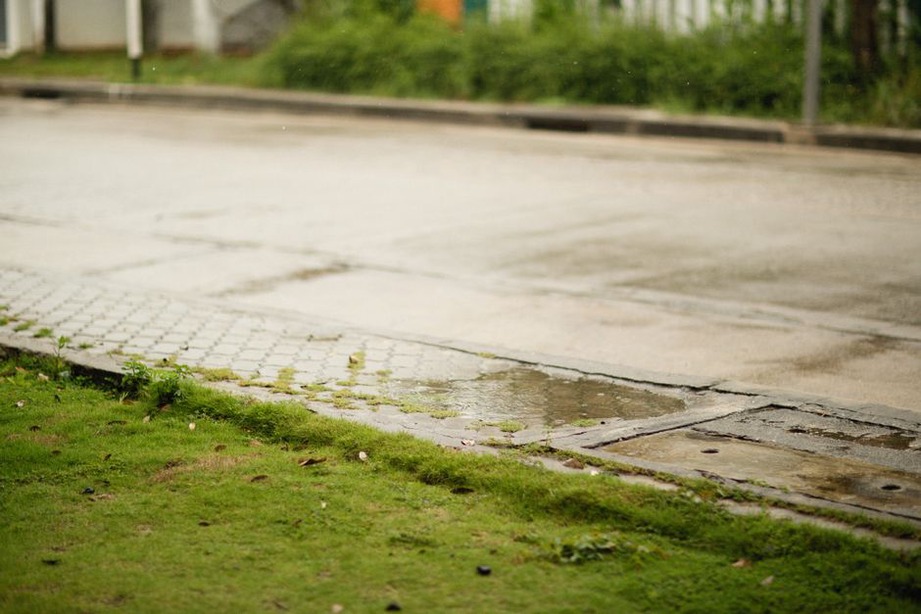
Vegetated swales and bioretention areas can slow and filter runoff, reducing peak flow to downstream conveyance. Their suitability beside a road depends on available space, soil conditions, maintenance access and whether infiltration is compatible with the pavement foundation. An unlined infiltration feature close to moisture-sensitive subgrade may add water to the very ground it is meant to protect. Lining or underdraining the feature may retain runoff-treatment benefits without deliberately wetting the formation.
Permeable surfacing may suit selected low-load areas and shoulders, but permeability is only the entry point. Water passing through the surface needs storage, a suitable infiltration route or a working underdrain. Fines from adjacent soil can clog voids; an undersized or blocked outlet can leave the reservoir layer saturated. The test is how reliably the whole system empties, not simply how quickly water enters.
Drain the pavement layers without losing their support
Open-graded drainage layers can carry infiltrated water laterally to an edge drain. They work best when the flow path is short enough, the layer stays permeable in service, and the receiving pipe or outlet can discharge freely. If fine soil migrates into the layer’s voids, both drainage and structural support can suffer.
Geotextiles and graded aggregate filters can protect that interface, but neither is a default substitute for the other. A filter must retain the relevant soil particles while passing enough water and surviving placement and compaction. A geocomposite drain offers a thin flow path where excavation depth is limited, though its capacity under long-term confinement and its susceptibility to clogging need examination. Laboratory properties measured without comparable loading or soil contact may not reflect field performance.
Edge drains are often installed during rehabilitation to connect an existing permeable base to an outlet without rebuilding the pavement. Elevation matters: a pipe set too high leaves water below its invert. Trench backfill needs a compatible filter arrangement and a way to maintain the drain. If the trench cuts through a supporting layer, poor compaction can create a new longitudinal weakness even when the hydraulic design is adequate.
Use capillary breaks for the right problem
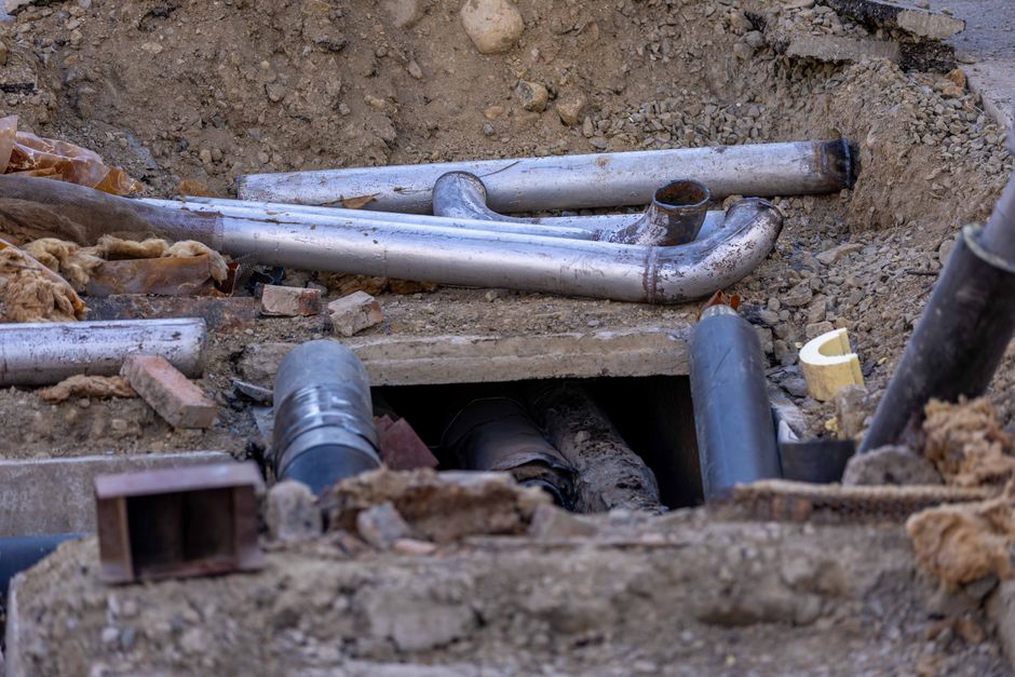
A coarse granular layer may interrupt upward capillary movement from fine soil; a drainage layer mainly carries free water laterally. The functions can overlap, but they are not equivalent. Fine-particle contamination can weaken a capillary break, while a permeable layer without an outlet can become a reservoir. At cuttings, embankments and structures, changes in material or level may also create local water traps.
Adapt drainage to constrained and variable sites
In a cutting, slope seepage can enter the pavement foundation even when the surface profile sheds rain. Interceptor drains or subsurface collectors may capture it before it reaches the road, subject to checks on slope stability and groundwater effects. Lowering water levels can change conditions beyond the pavement; the intervention is more than a pipe installation.
Bridge approaches, utility crossings and culvert backfills often contain abrupt changes in permeability that redirect water toward a less permeable layer. The resulting wet zone may be narrow enough to escape a corridor-wide assessment. Mapping these interfaces is often more useful than applying one drain detail along every chainage.
Steep or hazard-prone corridors bring debris and sediment into the drainage assessment. A collector that works with clean water may plug during a storm carrying eroded soil. The connection between drainage, unstable slopes and post-event access is discussed in assessing safety and recovery on mountain transport corridors. Here, accessible sediment traps and inspectable outlets may be more dependable in practice than extra buried capacity.
Design for blockage, inspection and replacement
Sediment, roots, crushed pipes, damaged outlet screens and changes in ground level can all reduce drainage performance. A small blockage at the discharge point may leave a long upstream section saturated. Plan for maintenance before installation:
- Locate outlets visibly. Record positions and elevations so crews can find them after vegetation growth or resurfacing.
- Provide practical access. Match cleanouts and inspection points to the drain geometry and likely cleaning method, rather than placing them only to satisfy a drawing.
- Control sediment at its source. Stabilize exposed shoulders and manage ditch erosion so fines do not repeatedly enter the drain.
- Protect discharge points. Limit erosion and avoid details that trap debris against the pipe opening.
- Preserve the flow path during repairs. Overlays, shoulder reconstruction and service trenches can seal an inlet or sever a collector.
A useful improvement may be a drain that can be checked, rather than a more elaborate one. Accessible outlets, replaceable components and inspection records tied to precise locations make its condition easier to establish. Embedded moisture or pore-pressure sensors may help on high-consequence sections, but readings need to be compared with rainfall, temperature and known ground conditions. One wet reading neither identifies the source nor proves drain failure.
Check performance after construction
Construction checks should confirm layer continuity, grades, filter placement and an open route to discharge. A pipe may meet its material specification but still fail to drain a low point below its outlet invert. Survey critical elevations and document concealed connections before backfilling; a final look at the pavement surface cannot verify them.
During service, inspect drainage alongside pavement condition. Persistent wet shoulders, pumping at joints, fines at an outlet, vegetation thriving over a drain trench and distress concentrated at a low point all warrant investigation. Compare observations in wet and dry periods to help separate runoff problems from sustained groundwater influence. Where instruments are justified, trends through storms and subsequent recession are more informative than isolated readings.
After a significant storm, a focused check can begin at the lowest outlet and follow the connected edge drain uphill. Record standing water, sediment and any gap between the pipe discharge and the receiving channel. That route check may expose a blocked exit before prolonged saturation produces visible pavement damage.