
A polymer-modified asphalt mix may resist wheel-path deformation in the lab yet crack early in service if it is poorly compacted or placed over a moving foundation. Before choosing it, ask which failure mechanism it addresses, under what loading and exposure conditions, and whether the expected benefit will survive construction.
Pavement life depends on the whole structure. Asphalt or concrete must withstand traffic, temperature changes, water and aging, while the base and subgrade provide stable support. New binders, aggregates and reinforcement products can extend service life, but they cannot make up indefinitely for trapped water, inadequate thickness or differential settlement. Material selection works best when it follows a defined performance requirement.
Start with the distress the material must resist
Permanent wheel-path deformation may develop in the asphalt, an unbound base or the subgrade. A stiffer surface mix can address deformation within that layer; it will not stop rutting caused by weak, wet support below. Cracks also have different origins: repeated bending under traffic, thermal contraction, movement in an underlying layer or joints reflecting through an overlay. Those mechanisms call for different combinations of stiffness, flexibility and bond.
A distress label alone is not enough. Cores can show layer thickness, cracking depth and adhesion; deflection measurements help assess structural response; material samples may reveal binder aging or moisture damage. The investigation should fit the decision. Surface renewal and reconstruction do not require identical evidence, but both require enough to distinguish a material problem from a support problem.
Asphalt binders: performance comes with processing demands
Polymer modification and aging resistance
Polymer-modified binders can improve resistance to deformation at high service temperatures and, depending on the formulation, elastic recovery. Results depend on polymer type, dosage, compatibility with the base binder and production history. A promising binder test does not establish how the finished mix will crack: aggregate structure, binder content, air voids and pavement temperature matter too.
Other binder technologies address aging, which can reduce asphalt's ability to relax stress and increase its susceptibility to cracking. Rejuvenating agents are often considered when reclaimed asphalt pavement contributes aged binder. But how much of that binder blends with new binder during production remains uncertain; assuming complete blending can misrepresent the effective binder grade. Mixture-level cracking and rutting tests, together with workability and uniformity checks, give a firmer basis for evaluation than an additive specification alone.
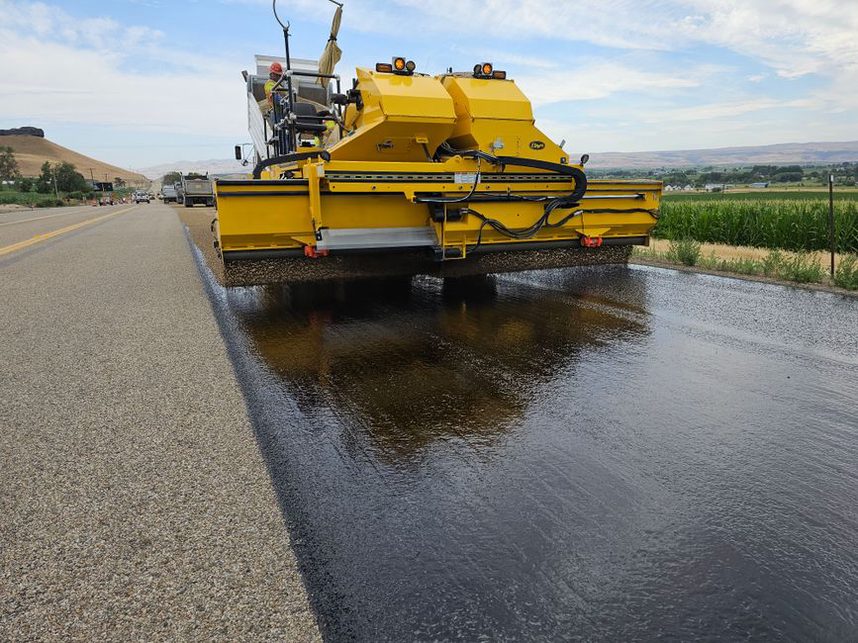
Warm-mix processes use chemical additives, foaming or other methods to lower production or compaction temperatures. Easier compaction may improve in-place density when a conventional mix would cool too quickly. Temperature reductions still have to allow adequate aggregate drying, coating and moisture resistance. Production temperature records and field density measurements can show whether the expected benefit reached the pavement.
Reclaimed and alternative constituents
Reclaimed asphalt pavement supplies aggregate and residual binder, reducing demand for virgin materials. More reclaimed material does not automatically mean a longer-lasting pavement. Stockpiles can vary in gradation, binder content and aging, while the finished mix still needs adequate rutting and cracking resistance. Fractionating stockpiles or tightening plant quality control can limit variability. Where available locally, recycled concrete aggregate, industrial by-products and alternative fillers need assessment for gradation, abrasion, absorption, contaminants and compatibility with the intended layer.
Crumb rubber and other modifiers can change binder or mixture response, but a performance claim needs to identify the material form, mixing process and comparison mix. Environmental assessment takes more than a count of recycled tonnes: hauling distance, processing energy, construction emissions and future intervention frequency can change the life-cycle result. A longer-lived surface may reduce future work if that service-life estimate rests on comparable exposure and maintenance assumptions.
Concrete pavements: durability at the paste and joint scales
Supplementary cementitious materials can reduce reliance on Portland cement and alter concrete permeability, heat evolution and long-term strength development. The effect depends on source material, dosage, curing and exposure. A mix that performs well after extended curing may not suit an early reopening schedule unless its initial strength gain is verified. Freeze-thaw conditions, deicing chemicals and harmful aggregate reactions also call for exposure-specific testing.
Fibers can help control crack width in some concrete applications, but they do not automatically replace joints or structural reinforcement. Joint spacing, saw-cut timing, load transfer and seal condition still determine where water enters and how wheel loads cross a discontinuity. Low-permeability concrete offers limited protection if joints admit water into an erodible base. Trials should record joint condition and edge distress alongside slab strength, so an interface failure is not mistaken for a mixture failure.
Base materials and interlayers: check the load path
Stabilized bases, including cement- and bitumen-treated materials, can increase stiffness and limit traffic-induced deformation. That stiffness changes how the pavement behaves; it is not simply an increase in strength. A bound layer that shrinks or cracks may transmit cracks upward. Cement-treated material can also suffer if curing is inadequate or support uneven. Selection must account for drainage, expected movement and the overlay's capacity to accommodate it.
Geosynthetics and asphalt interlayers serve different purposes. A separator keeps fine subgrade soil from contaminating a granular base. Reinforcement may limit lateral movement or redistribute strain where confinement is suitable. A stress-absorbing interlayer may delay reflection cracking by reducing strain concentration over an existing crack or joint. None is a universal waterproofing or structural substitute. Installation damage, wrinkles, poor anchorage or weak bond can erase the intended benefit or create a slip plane.
Water control belongs in the material decision. Persistent saturation can weaken unbound layers and promote stripping in asphalt. The route from the pavement edge to a functioning outlet matters as much as a base's nominal permeability; tracing road drainage paths and maintaining outlets addresses that operational side of durability.
How to test a candidate before scaling it up
Product literature often highlights one favorable property, though pavement survival depends on competing demands. A mix that resists rutting may be too brittle for local temperatures. A permeable surface may drain quickly but still need a compatible structure and a plan for clogging. Compare candidates with a reference mix or existing section under the same intended traffic, climate and layer arrangement.
- Define the baseline: record distress type, layer condition, support variability and the current maintenance interval.
- Specify performance measures: select relevant laboratory indicators for deformation, cracking, moisture susceptibility or freeze-thaw durability instead of relying on one index.
- Verify constructability: check mixing, transport, placement temperature, compaction window and achievable density or curing under site conditions.
- Build a monitored trial: include a documented control section where practical, and record thickness, material batches, weather and installation deviations.
- Inspect over time: track where distress appears and how it progresses, rather than judging the surface only soon after opening.
The trial must be large and representative enough to encounter the relevant traffic and drainage conditions. A short section cannot prove decades of service, but it can reveal segregation, bond failure, unexpected cracking or maintenance needs before wider adoption. Repeat measurements at consistent locations using consistent methods, or seasonal changes may be mistaken for deterioration.
Specify the outcome without losing control of installation
Performance-based requirements can leave room for alternative materials, but acceptance still depends on what can be measured during construction. In asphalt, plant consistency, layer thickness, in-place density and bond between lifts may matter more than small differences in laboratory formulation. In concrete, the air system, placement quality, curing and joint construction need similar attention. Sampling should reflect variability across the site; one passing sample cannot represent an entire production run.
For a corridor with known wheel-path distress, locate the deformation in a core or trench before approving a new surface mix, then compare the finding with structural response measurements. Rutting confined to the upper asphalt layer gives a mixture trial a clear target. If the base or subgrade has deformed, hold that trial until the support mechanism has been addressed.