
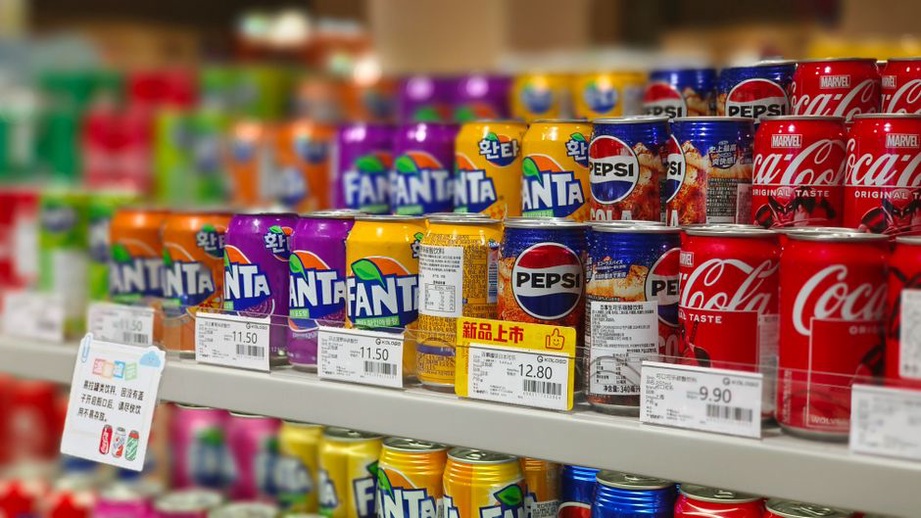
A $4.50 bag of rice may cost more than a $5.20 bag once you account for size. If the first holds 1.5 kilograms and the second holds 2 kilograms, they cost $3.00 and $2.60 per kilogram, respectively. The shelf price tells you what you will spend today; the unit price shows how much rice you get for that money.
Start with a common unit
To find the unit price, divide the package price by the quantity on the label. Compare dollars per kilogram, per litre, per 100 grams, or per item—but use the same unit for both products. A price of $0.36 per 100 grams equals $3.60 per kilogram. If shelf tags use different units, divide price by quantity and convert one result to match the other.
Check what the stated quantity measures. Net weight, drained weight, and number of pieces answer different questions. For canned beans, drained weight may better reflect the food you plan to eat; for broth, the full liquid volume matters. If eggs are priced per dozen on one label and per egg on another, convert them to the same count.
When the unit price needs an adjustment
Equal purchased weight does not always mean equal usable food. A whole pineapple includes peel and core, while prepared pineapple has less waste. If you expect to use only 60% of the whole fruit's weight, divide its price by that usable amount. A $3 item yielding 600 grams of fruit costs $5 per kilogram eaten. That yield is an estimate; it depends on produce quality and how closely you trim it.
For concentrates, compare the cost per prepared litre using the package's dilution instructions—assuming you would prepare both products at those strengths. Coffee calls for a similar check: compare what you spend for the amount you typically use per cup, rather than assuming equal package weights make equal numbers of cups.
Apply the discount to the quantity you must buy
A promotion counts only if you meet its conditions. With a “buy two for $6” offer, check whether one costs $3 or keeps a higher individual price. For “buy one, get one free,” divide the total paid by the combined quantity only if you can use both packages. A loyalty-card price is relevant only if you have the card and the offer applies at checkout.
For a percentage discount, work out the reduced price before dividing by quantity. A package normally priced at $5 costs $4 after a 20% discount, before any applicable tax. At 800 grams, that is $5 per kilogram. Compare that figure with the alternative's unit price, not just its shelf price. If the products are taxed differently, compare their expected checkout totals.
Check minimum-purchase thresholds, quantity limits, and coupons restricted to certain sizes. A $1 coupon on a large package may still leave it dearer per unit than a smaller store-brand pack. If a discount requires an unrelated purchase, count that spending rather than treating the discount as free savings.
Count what will be eaten, not merely bought
The cheapest unit price can be misleading when food spoils. Suppose 500 grams of spinach costs $4, while a 250-gram bag costs $2.50. The larger bag is $8 per kilogram, compared with $10 for the smaller one. But if you eat only 300 grams before the larger bag deteriorates, you have spent about $13.33 per kilogram eaten. The smaller bag remains $10 per kilogram if you finish it.
This matters most for produce, fresh herbs, bread, and other foods you cannot reliably keep. Frozen or shelf-stable alternatives may have a higher or lower labeled unit price, but can mean less waste when you use small amounts. Storage space matters too: several discounted bulk packs may crowd out food that needs prompt refrigeration.
Compare equivalent products
A low price sometimes reflects a different product, not a bargain. For sauces, cereals, and dairy products, check ingredients and intended use. Added water, different protein content, or a change in concentration may affect how much a recipe needs. Compare plain with plain and flavored with flavored when that distinction matters. For meat and fish, bone, skin, and liquid in the package can reduce the edible amount.
Preference matters as well. If your household will not eat a product because of its texture, its low unit price is of little use. Ask whether the cheaper option works in the meal you intend to make: a lower-cost tomato product might suit a cooked sauce even if you prefer another brand in an uncooked dish.
Include the costs the shelf tag leaves out
- Preparation: Dried beans often cost less per serving than canned beans, but soaking and cooking take time, water, and energy. Compare prepared portions if convenience affects what you will actually cook.
- Travel or delivery: A lower price at another store may disappear once you add a delivery fee or an extra trip. Spread a fixed fee across the items you would buy there instead of assigning it all to one product.
- Cash available now: A bulk pack may cost less per unit but require more money today. It only helps if the purchase fits the rest of your grocery budget.
- Storage: Bulk savings depend on keeping the food safe and usable for long enough.
For staples you buy often, keep a short record of the product, package size, checkout price, and comparable unit price. It is easier than trying to remember every sale. Prices change by store and date, so a past low price is a reference point, not a promise.
Before choosing a size, calculate the price for the amount you expect to eat. If a 900-gram tub costs $5.40 but you usually discard 150 grams, divide $5.40 by the 0.75 kilograms you use. That is $7.20 per kilogram eaten, rather than the $6.00 per kilogram on the shelf tag.