
A foundation may satisfy structural strength checks and still perform poorly when the ground model is incomplete. Excess settlement beneath an abutment, lateral movement near a retaining-supported approach, or reduced bearing resistance during high water can alter the load path between a transport structure and the soil. Soil mechanics provides the basis for predicting these interactions before construction and checking whether field performance matches the design assumptions.
For roads, railways, bridges, stations, and ancillary structures, a foundation is more than the concrete element below ground. It includes the footing, piles or ground-improvement zone, natural or engineered strata, groundwater regime, and loads applied over time. Performance depends on stress, deformation, drainage, and the unavoidable variability of natural deposits.
Why soil behavior governs foundation performance
Soils differ fundamentally from manufactured structural materials. Their stiffness and strength depend on density, stress history, water content, drainage conditions, fabric, and loading rate. A clay deposit may carry a short-term construction load without visible distress, then consolidate gradually as excess pore-water pressure dissipates. Loose saturated sand may have adequate static bearing capacity while remaining susceptible to cyclic densification, lateral spreading, or liquefaction during an earthquake.
Foundation design must therefore consider more than ultimate capacity. Serviceability matters: settlement, differential movement, rotation, lateral deflection, and vibration-related response can affect tracks, pavement transitions, bearings, utilities, and drainage systems. Even small movements can be significant for transport assets. Modest differential settlement at a bridge approach can create a ride-quality defect and increase impact loads. Along rail corridors, uneven support can accelerate track-geometry deterioration and raise maintenance demand.
The ground investigation as the basis of design
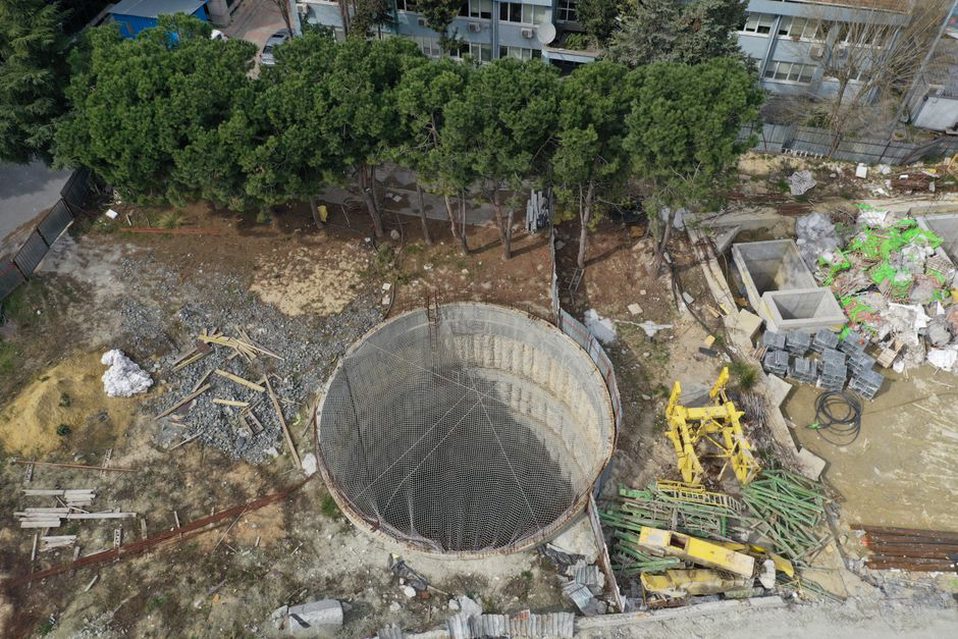
Soil-mechanics calculations are only as credible as the site characterization behind them. The investigation should establish stratigraphy, the extent of critical layers, groundwater conditions, geological hazards, and the engineering properties required for the selected foundation concept. Boreholes alone are rarely enough where deposits vary across an alignment or beneath a large foundation footprint. A coordinated program may combine boreholes, test pits, in-situ penetration testing, pressuremeter or vane testing where appropriate, geophysical methods, groundwater observations, and laboratory testing of carefully selected samples.
Parameters are not interchangeable
Each design question requires parameters that represent a specific mechanism and drainage condition. Undrained shear strength is relevant to short-term loading in saturated fine-grained soils. Effective-stress strength parameters are needed for long-term stability and seepage-related conditions. Compressibility and consolidation properties support settlement analysis. Small-strain and working-strain stiffness inform deformation predictions, while permeability affects drainage time, seepage forces, and the feasibility of dewatering.
A laboratory value should not be treated as a fixed property for an entire stratum. Sample disturbance, test method, stress path, anisotropy, seasonal groundwater variation, and local layering can all affect its relevance. Engineering judgment should establish representative parameter ranges from several lines of evidence rather than select a convenient single value.
Groundwater is a design variable
Water pressure changes effective stress: the stress carried by the soil skeleton. Rising groundwater can reduce effective stress and shear resistance, while excavation or pumping can induce consolidation settlement beyond the immediate work area. Flowing water may also cause internal erosion in susceptible materials or undermine fine-grained filters and drainage details. A groundwater level measured on one day is not necessarily an appropriate design level; monitoring through relevant seasonal and construction periods may be needed.
These issues are particularly demanding around excavations and underground assets, where support systems, water control, and deformable ground interact. The subject is examined in Underground Transport Infrastructure: Key Geotechnical, Water and Operational Design Issues.
Core soil-mechanics checks in foundation design
A sound design considers several limit states rather than relying on a single bearing-capacity calculation. The governing condition varies with the structure, ground profile, load combination, and construction sequence.
| Design issue | Soil-mechanics basis | Potential infrastructure consequence |
|---|---|---|
| Bearing resistance | Shear failure and stress distribution below a foundation | Sudden footing failure or excessive localized deformation |
| Total settlement | Elastic response, compression, and consolidation | Low clearances, grade changes, drainage reversal |
| Differential settlement | Variable stiffness, thickness, loading, or fill conditions | Cracking, approach bumps, track irregularity |
| Lateral response | Soil pressure, pile-soil interaction, slope movement | Foundation displacement and overstressed structural elements |
| Uplift and flotation | Buoyancy, groundwater pressure, interface resistance | Instability of buried structures or lightly loaded foundations |
| Seismic ground response | Cyclic strength, pore-pressure generation, dynamic stiffness | Settlement, lateral spreading, loss of support |
Bearing resistance and the limits of simple formulas
Shallow foundations transfer load through contact pressure across their footprint and by stresses spreading into the underlying soil. Bearing resistance depends on foundation geometry, embedment, soil strength, groundwater, load inclination, nearby slopes, and weaker layers at depth. A strong crust over soft clay can give a misleadingly favourable result if deeper punching or overall stability mechanisms are ignored.
For deep foundations, capacity includes shaft resistance and base resistance, although the balance between them can change with construction method and loading. Driven piles may densify some granular soils. Bored piles may disturb or soften the base where construction control is inadequate. Negative skin friction can add load to a pile when surrounding compressible soil settles relative to the shaft, for example after placement of approach-embankment fill.
Settlement is often the governing criterion
Settlement estimates combine several components. Immediate settlement results from deformation during or shortly after loading. Primary consolidation occurs as saturated, low-permeability soils expel water under increased effective stress. Secondary compression can continue after primary consolidation, particularly in organic soils and certain sensitive or highly plastic clays.
Total settlement alone is not enough. Differential settlement along a footing, between adjacent piers, or across a road-to-bridge transition often has greater operational consequences. Analysis should reflect staged loading, such as embankment placement before deck construction, and the time needed for consolidation. Where preload or vertical drainage is proposed, its effectiveness should be checked against the actual drainage path and soil permeability rather than assumed from a generic construction schedule.
Choosing the foundation response, not just the foundation type
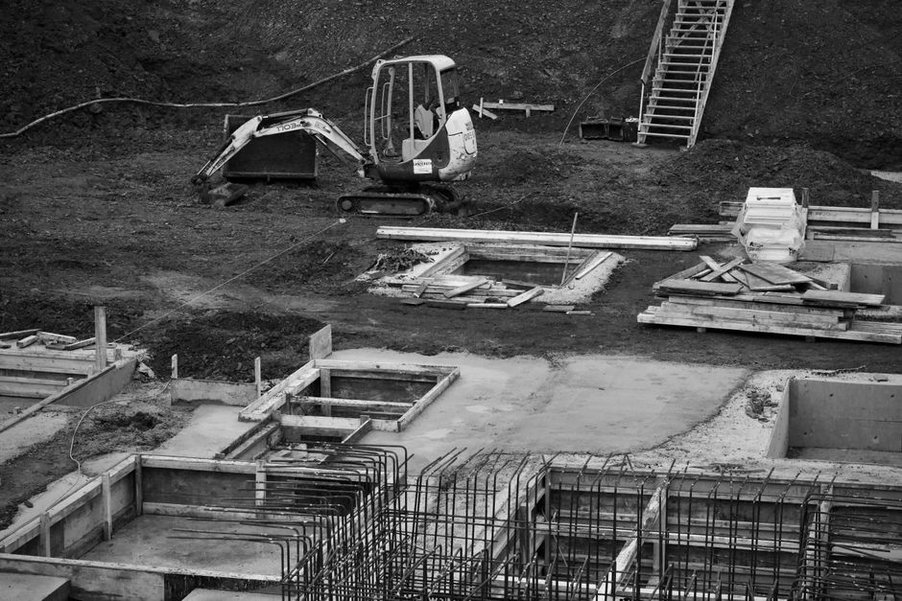
Shallow footings are efficient where competent material lies near grade and predicted movements are acceptable. Raft foundations distribute load over a wider area and can reduce contact stresses, but they do not eliminate settlement where thick compressible deposits extend below. Deep foundations transfer loads to deeper competent strata or mobilize resistance along their length. They may be selected for settlement control, lateral capacity, scour considerations, or construction constraints as much as for vertical capacity.
Ground improvement can change the response of the soil-foundation system by densifying granular deposits, reinforcing weak ground, accelerating consolidation, replacing unsuitable material, or reducing permeability. Its suitability depends on soil type, depth, groundwater, required performance, and the ability to verify the treatment. A method that increases strength may still lack the uniformity needed to control differential settlement. Conversely, a method intended to reduce settlement must be assessed for construction-induced lateral movement that could affect nearby tracks, utilities, or structures.
Selection is iterative: characterize the ground, evaluate feasible systems, model performance, consider buildability and quality assurance, then refine the design against verified conditions. The assessment should include temporary states during excavation, dewatering, pile installation, surcharge placement, and traffic staging, not only the completed asset.
Soil-structure interaction and construction sequence
Structural loads change stress in the soil, and soil deformation redistributes forces back into the structure. This interaction is especially important for continuous bridge decks, piled abutments, retaining systems, tunnels near foundations, and long linear works crossing variable ground. A model that assumes perfectly rigid supports may miss load redistribution caused by unequal foundation stiffness. Soil springs assigned unrealistic stiffness can underpredict deflection and conceal critical demands.
Construction sequence also changes the stress path. Excavation beside an existing footing removes confinement and may induce movement. Fill placed behind an abutment raises lateral pressure and can trigger consolidation settlement in foundation soils. Dewatering may affect a wider area than the excavation footprint. On complex works, an observational approach may be appropriate: define predicted behaviour and action thresholds, instrument critical locations, compare measured response with expectations, and alter the work only through controlled engineering procedures.
Field verification and monitoring
Verification helps close the gap between the ground model and actual construction conditions. Depending on the foundation system, it may include inspection of footing subgrades, pile proof or performance testing, integrity testing, load testing, compaction and improvement verification, settlement plates, inclinometers, piezometers, and precise survey monitoring. These methods do not replace design; they test assumptions associated with significant uncertainty or consequence.
- Define acceptance criteria early: inspection and test requirements should relate directly to the design mechanism being verified.
- Record deviations spatially: an unexpected weak layer or high groundwater reading is useful only when its location, depth, extent, and response are documented.
- Interpret trends rather than isolated readings: the rate of settlement or pore-pressure dissipation may be as important as the measured value.
- Maintain traceability: field logs, laboratory results, construction records, and monitoring data should be linked to the final ground model.
Managing uncertainty without false precision
Natural ground cannot be characterized with the certainty available for factory-produced materials. The appropriate response is not excessive numerical precision, but explicit risk management. Critical uncertainties may include rock depth, continuity of soft seams, artesian pressures, fill composition, collapsible or expansive behaviour, and the cyclic response of loose saturated soils. Their consequences should influence investigation density, parameter selection, analysis methods, contingency measures, and monitoring plans.
Independent review is particularly valuable where failure could affect operational railways, major bridges, densely built corridors, deep excavations, or lifeline routes. It can test whether the conceptual ground model is plausible, whether the analysis addresses the governing mechanisms, and whether construction controls are adequate for the identified risks.
Consider a bridge abutment approaching soft clay. Plot predicted settlement against time for each construction stage, then compare the results with settlement-plate and piezometer readings after fill placement. If pore pressures dissipate more slowly than assumed, subsequent loading should not continue to the original schedule without reassessing stability and long-term movement.