
A pavement may use sound asphalt or concrete yet still deteriorate early if the supporting ground loses strength, changes volume, or retains water. Wheel loads spread through the pavement layers, but the subgrade carries the accumulated stress. Its stiffness, uniformity, drainage condition, and seasonal response influence rutting, cracking, settlement, and maintenance demand throughout the road’s service life.
Soil is not a fixed construction platform. Moisture changes with rainfall, runoff, groundwater, thaw, leakage, and drainage performance. Fine-grained soils can soften markedly when wet; expansive clays swell and shrink; loose granular deposits may densify under repeated loading; and organic soils can continue compressing for years. These processes need to be treated as design and asset-management inputs, not as isolated construction issues.
The subgrade as part of the pavement system
The subgrade is the prepared upper zone of natural ground or engineered fill beneath the pavement structure. It is more than a formation level. Its resilient response to traffic loading affects the bending of the base, subbase, and surfacing layers. A weak subgrade forces the pavement to bridge greater deflections, while variable support causes adjacent sections to react differently under the same axle load.
Subgrade performance depends on several interacting properties:
- Strength and stiffness: the ability to resist shear deformation and recover under repeated loading.
- Moisture sensitivity: the extent to which strength falls as water content increases.
- Compressibility: the potential for settlement under embankment weight and traffic.
- Permeability and drainage: the rate at which water enters, moves through, and leaves the soil.
- Volume-change potential: swelling, shrinkage, frost heave, collapse, or settlement caused by environmental change.
- Spatial consistency: abrupt transitions between soil types, fills, rock, or former excavations.
An average strength value can conceal a serious local weakness. Over a short distance, a road alignment may pass through competent sand, soft alluvium, weathered rock, and uncontrolled fill. Differential movement at these transitions often causes cracking, bumps, and repeated localized repairs.
Soil types and the distress patterns they promote
Fine-grained silts and clays
Silts and clays are strongly governed by water content. As saturation rises, pore-water pressure can reduce effective stress between particles, lowering stiffness and shear resistance. Under traffic, a softened subgrade permits greater pavement deflection. Flexible pavements may then develop wheel-path rutting, fatigue cracking, and depressions that retain more water.
Fine-grained soils may also be prone to pumping, where repeated loads move water and fine particles through cracks, joints, or layer interfaces. In rigid pavements, loss of support beneath slabs can contribute to faulting and corner distress. The defect appears at the surface, but the initiating mechanism may lie in water and mobile fines below.
Expansive clay
Some clay minerals undergo substantial volume change as moisture conditions vary. Seasonal wetting can cause heave, while drying can lead to shrinkage and cracking. The main concern is usually differential movement rather than uniform movement. Vegetation, drainage routes, shaded areas, shoulder treatment, and utility trenches can all create uneven moisture conditions along one roadway.
Typical signs include longitudinal cracking, edge deformation, localized humps, and recurring roughness. Replacing a damaged surface without correcting moisture pathways or addressing the active soil zone may only delay the problem.
Granular soils
Well-graded granular soils generally drain more readily and can provide good support when properly compacted. That does not make them automatically dependable. Loose sands and gravels may densify under vibration and repeated loading, producing settlement. Poorly graded material can be difficult to compact uniformly, while fines contamination may reduce drainage and change the behavior of a layer assumed to be free-draining.
In loose, saturated granular deposits susceptible to seismic effects, shaking may cause a marked loss of strength through liquefaction or cyclic mobility. The consequences can extend beyond pavement damage to embankments, retaining structures, approaches, and buried utilities. The interaction between ground behavior and route continuity is examined in seismic resilience in highway design and corridor function after earthquakes.
Organic and highly compressible soils
Peat, organic silt, soft clay, and some uncontrolled fills can compress significantly beneath embankments and pavements. Consolidation may continue slowly as water is expelled from low-permeability layers. Where deposit thickness varies, settlement varies as well, producing dips, cracking, shoulder separation, and drainage reversals. Organic soils may also have low strength and can be difficult to characterize from sparse sampling because their composition changes over short distances.
Collapsible soils and soluble ground
Some unsaturated soils have an open particle structure that appears stable while dry but collapses when wetted under load. In areas containing soluble rock or erodible deposits, subsurface voids and internal erosion need separate investigation. Sudden settlement in these settings is not ordinary pavement wear; it is a ground-risk condition that calls for appropriately scoped geotechnical assessment and monitoring.
Water is usually the controlling variable
Water reaches road structures by far more routes than direct rainfall. Surface runoff can infiltrate through cracks and unsealed shoulders. Groundwater may rise seasonally. Water can also enter through side ditches, irrigation, damaged pipes, or poorly controlled construction runoff. In cold climates, freezing fronts and thaw cycles redistribute water and change support conditions.
Once water reaches susceptible layers, the effects can compound. Reduced subgrade strength causes deformation; deformation forms low points; low points retain water; and retained water accelerates further weakening. A durable road section depends on continuity between pavement drainage, shoulders, edge details, cross-drainage, outlet protection, and subsurface water control. Drainage assets must remain functional after construction, when sediment, vegetation, traffic damage, and deferred cleaning can reduce capacity.
| Ground or water condition | Likely pavement response | Useful diagnostic evidence |
|---|---|---|
| Seasonally wet fine-grained subgrade | Rutting, alligator cracking, soft shoulders | Moisture profiles, deflection trends, ditch and outlet inspections |
| Variable fill or compressible deposit | Differential settlement and localized roughness | Survey levels, borehole logs, construction records, settlement monitoring |
| Expansive clay with uneven wetting | Heave, longitudinal cracking, recurring distortion | Plasticity and swell testing, vegetation and drainage mapping |
| Frost-susceptible soil with poor drainage | Seasonal heave, thaw weakening, surface breakup | Soil gradation, groundwater observations, temperature and condition records |
Construction quality: preserving the design assumptions
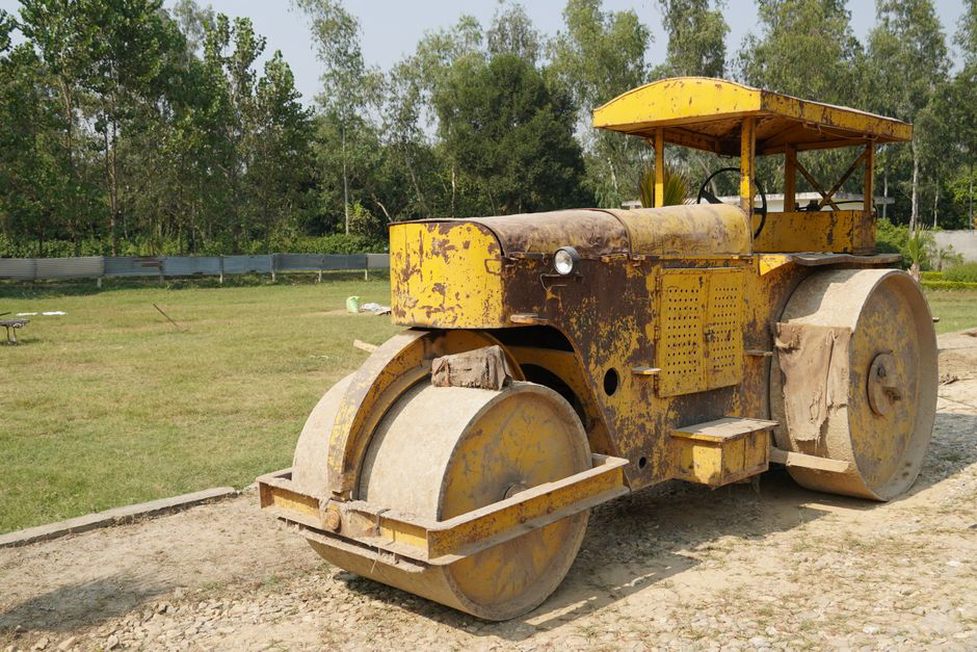
A well-developed ground model can be undermined by unsuitable construction conditions. Compaction near optimum moisture content is often necessary to achieve the intended density and stiffness, but field conditions can change quickly. Soil that is too wet may compact poorly and lose strength later; soil that is too dry may resist densification or break down under rollers. Compaction should be controlled through project-specific acceptance methods and, where needed, supported by proof rolling, in-situ testing, or stiffness measurements.
Construction traffic can damage exposed formation soils, particularly after rain. Rutting and remolding of a fine-grained subgrade may create a weak zone before pavement layers are installed. Segregated aggregate, contaminated drainage layers, inadequate geosynthetic overlaps, and unprotected edges can likewise compromise the intended support system.
Material boundaries deserve close attention. A transition from cut to fill, rock to soil, or natural ground to trench backfill can concentrate differential movement. The aim is not to remove every difference in ground response, which is rarely practical. It is to identify transitions, control their construction, and verify that the completed formation performs consistently enough for the pavement system.
Investigation should follow the anticipated failure mechanisms
Road geotechnical investigations need longitudinal coverage and a depth appropriate to the proposed earthworks and expected groundwater regime. Boreholes, trial pits, sampling, in-situ testing, geophysical methods, and laboratory testing each reveal different aspects of the ground. Their value lies in building a defensible ground model rather than producing isolated test results.
A route across soft ground may require attention to layer thickness, drainage paths, consolidation behavior, and the embankment loading sequence. In expansive clay, the investigation needs information on mineralogy, plasticity, moisture variation, and the depth affected by climate and vegetation. In frost-prone terrain, gradation, fines content, drainage, frost penetration, and spring-thaw behavior may be more informative than a dry-season strength result alone.
Existing information should be used carefully. Historical maps, aerial imagery, maintenance records, utility drawings, earlier boreholes, and records of former ponds, quarries, or landfills can reveal anomalies that a regular investigation grid may miss. Their reliability still requires field verification.
From observed distress to a credible cause
Maintenance decisions are stronger when surface damage is distinguished from support failure. A crack pattern alone does not prove a subgrade problem. Investigators should combine visual condition data with drainage inspections, coring, layer-thickness checks, deflection measurements, level surveys, traffic history, and targeted subsurface exploration.
- Map the extent and geometry of distress. Record whether it follows wheel paths, edges, joints, culverts, embankment toes, utility corridors, or soil transitions.
- Establish timing. Compare the onset with rainfall, thaw, new construction, drainage changes, increased loading, or nearby excavation.
- Check water pathways. Inspect ditches, outlets, edge seals, culverts, joints, and evidence of leakage or ponding.
- Measure structural response. Use suitable deflection, profile, and material investigations to determine whether support has been lost or pavement layers are inadequate.
- Target the intervention to the mechanism. Surface renewal may suit superficial aging, while moisture-related subgrade weakening requires restoration of drainage and support conditions.
This cause-based approach supports effective renewal. The choice between localized repair, structural strengthening, drainage correction, reconstruction, or ground improvement should follow verified mechanisms rather than surface appearance alone. A related discussion of treatment selection appears in innovative approaches to pavement rehabilitation, with emphasis on matching rehabilitation methods to pavement condition and underlying needs.
Monitoring soil-related road risk over time
Road agencies often hold useful early-warning information without identifying it as geotechnical data. Repeated surveys of rut depth and roughness, maintenance callouts after storms, blocked-drain records, shoulder repairs, and seasonal defect maps can point to persistent wet zones or moving ground. Combining these records with rainfall, groundwater, and topographic information can help prioritize inspections before a defect becomes a structural failure.
At higher-risk sites, monitoring may include settlement plates, inclinometers, piezometers, moisture sensors, survey targets, or remote sensing. Instrument selection should match the expected process and the decision it is meant to inform. A piezometer is useful where pore-pressure changes may control stability or strength; it is less useful when the unresolved question is whether a shallow asphalt layer has fatigued. Thresholds, reading frequency, maintenance responsibilities, and response actions should be established before data collection starts.
For a recurring wet wheel-path failure, a practical sequence is to survey the profile, inspect and clear drainage outlets, obtain cores and layer-thickness data, measure structural response in damaged and intact areas, and then test the subgrade at representative moisture conditions. If the damaged location shows elevated moisture, reduced support, and a blocked upstream outlet, the repair scope can focus on restoring drainage and rebuilding weakened layers rather than applying another surface overlay.