
A highway may look intact after an earthquake and still be unsafe to reopen. A few centimetres of fault displacement, settlement at an abutment, lateral spreading beside an embankment, or a blocked drainage crossing can sever an otherwise undamaged route. Seismic resilience therefore depends on the performance of the whole corridor: pavement, earthworks, foundations, bridges, retaining systems, tunnels, drainage, utilities, and the operational links between them.
For highway owners, the aim is rarely limited to preventing collapse. They need to define the damage a route can tolerate and the time allowed to restore safe traffic, particularly where it supports emergency response or access to hospitals, ports, airports, and isolated communities. Those decisions need to be made early, since they affect alignment selection, investigation scope, structural detailing, and the availability of repair materials after an event.
Start with corridor-level seismic hazards
Ground shaking is only one of the demands created by an earthquake. Resilient design starts by identifying hazards along the full route and linking them to individual assets. Conditions can change sharply over short distances where a highway crosses alluvial valleys, steep terrain, reclaimed land, river terraces, or active fault zones.
- Surface fault rupture: permanent offset can shear pavements, culverts, retaining walls, and bridge approaches.
- Strong ground motion: inertial forces affect bridges, walls, sign structures, portals, and slopes.
- Liquefaction and cyclic softening: saturated loose soils may lose stiffness and strength, leading to settlement, bearing failure, lateral spreading, or uplift of buried structures.
- Earthquake-induced landslides: cuts, natural slopes, and rock faces may fail during or after shaking.
- Seiche, tsunami, or river effects: where relevant, seismic events may coincide with scour, flooding, and debris impacts at crossings.
- Aftershocks: damaged slopes and partially displaced structures remain vulnerable while inspections and repairs are under way.
Hazard mapping should be detailed enough to identify susceptible foundation zones, unstable slope segments, fault crossings, and locations where one failure could break network continuity. The investigation should also address groundwater levels, stratigraphy, soil density, plasticity, rock discontinuities, and the potential for drainage conditions to change after shaking.

Alignment and redundancy reduce exposure before detailing begins
Avoiding a poor site is usually more dependable than trying to strengthen it after the route has been fixed. Where alternatives exist, planners can reduce future vulnerability by avoiding active fault traces, deep liquefaction-prone deposits, unstable valley-side terrain, and narrow corridors without a practical detour. Environmental, geometric, and social constraints still matter, but seismic exposure should be weighed alongside cost and constructability during alignment selection.
Network resilience also depends on redundancy. A high-capacity highway that relies on a single major viaduct, tunnel portal, or slope-prone pass has a concentrated failure point. Alternative crossings, parallel access routes, crossover provisions, and staged traffic-management plans can limit the operational consequences when the main facility needs repair. This is as much an operational design matter as a structural one.
Earthworks and pavement: control permanent ground deformation
Flexible pavement can tolerate modest deformation better than rigid or highly restrained elements, yet it cannot bridge major differential settlement or lateral ground movement indefinitely. The key task is often to limit deformation in the supporting ground and make the route practical to inspect and repair after an event.
Embankments on susceptible ground
Embankments magnify the effects of weak or saturated foundation soils. Under cyclic loading, loose granular layers may densify and settle, while sensitive or soft fine-grained soils may lose strength. Differential movement can crack pavement, distort barriers, damage buried drainage, and create abrupt level changes that make emergency travel hazardous.
Potential measures, selected through site-specific analysis, may include ground densification, replacement of unsuitable material, drainage and groundwater control, deep soil improvement, reinforced embankment zones, flatter slopes, or foundation systems that transfer load to more competent strata. The appropriate option depends on deformation criteria, construction access, soil variability, environmental constraints, and the expected ability to inspect and repair the asset.
Transitions need particular attention. Bridge approaches, culvert crossings, retaining-wall interfaces, and changes between cut and fill concentrate stiffness contrasts. A design that performs well at the centre of an embankment may still create a damaging bump at an approach slab or settlement at a culvert inlet. Where ground behaviour is uncertain, instrumented trial sections and construction-stage observations can provide useful evidence.
Slopes, cuts, and retaining systems
Seismic slope design must consider shaking-induced movement as well as the condition left after the event. Rockfall, shallow slides, deep-seated failures, and debris flows can all close a highway. The acceptable level of displacement varies by location: limited movement may be manageable in a remote cut with clearance space, while similar deformation at a bridge abutment or tunnel portal may be unacceptable.
Effective measures often combine geometry, drainage, reinforcement, erosion protection, catchment space, and monitoring. Retaining walls need compatible treatment of seismic soil pressures, foundation behaviour, drainage reliability, and the displacement capacity of connections. The companion discussion of landslide risk mitigation in road design provides further context on incorporating slope hazards into route decisions.
Bridges require ductility, movement capacity, and dependable connections
Bridges are often the most consequential highway assets because losing one can eliminate a corridor crossing. Their seismic response depends on the complete load path: deck, bearings, piers, foundations, abutments, and surrounding soil. Strong columns alone are not enough if bearings unseat, expansion joints bind, abutments settle, or foundation soils spread laterally.
| Component | Seismic vulnerability | Resilience focus |
|---|---|---|
| Deck and joints | Unseating, pounding, joint damage | Adequate seat lengths and controlled movement paths |
| Bearings and restrainers | Excessive displacement or loss of support | Inspectable devices with defined load-transfer roles |
| Piers and columns | Brittle shear failure or inadequate confinement | Ductile response and protected critical regions |
| Abutments and approaches | Settlement, spreading, backfill movement | Soil-structure interaction and transition performance |
| Foundations | Liquefaction, scour, lateral soil movement | Capacity under combined ground and structural demands |
Seismic isolation and energy-dissipation devices can reduce force demands in suitable configurations, but they also create requirements for inspection, replacement, clearance, and long-term maintenance. Their value depends on reliable modelling of expected movement, temperature effects, service loads, and the behaviour of adjacent components. Details should avoid unintentionally restraining a nominally flexible system through utilities, barriers, joints, or approach components.
Foundations require early coordination between geotechnical and structural engineers. Pile or shaft performance is influenced by inertial loads from the superstructure and by movement in the surrounding ground. In liquefiable or laterally spreading deposits, the ground can impose substantial kinematic demands on foundations even where bridge mass is modest.
Drainage and lifelines are part of seismic performance
Drainage failures can extend an earthquake-related closure. Cracked pipes, distorted culverts, blocked inlets, and damaged channels may saturate an embankment or undermine pavement during the first rainstorm after the event. Where differential ground movement is credible, drainage systems benefit from accessible inspection points, movement-tolerant joints where appropriate, protection at crossings, and practical means of clearing debris.
Highway corridors also carry or intersect power, communications, fuel, and water infrastructure. Their failure can affect traffic control, tunnel safety, lighting, pumping, and emergency operations. Coordinating movement allowances and shutoff arrangements among asset owners reduces the risk that a utility failure delays reopening of a road whose primary structure has survived.
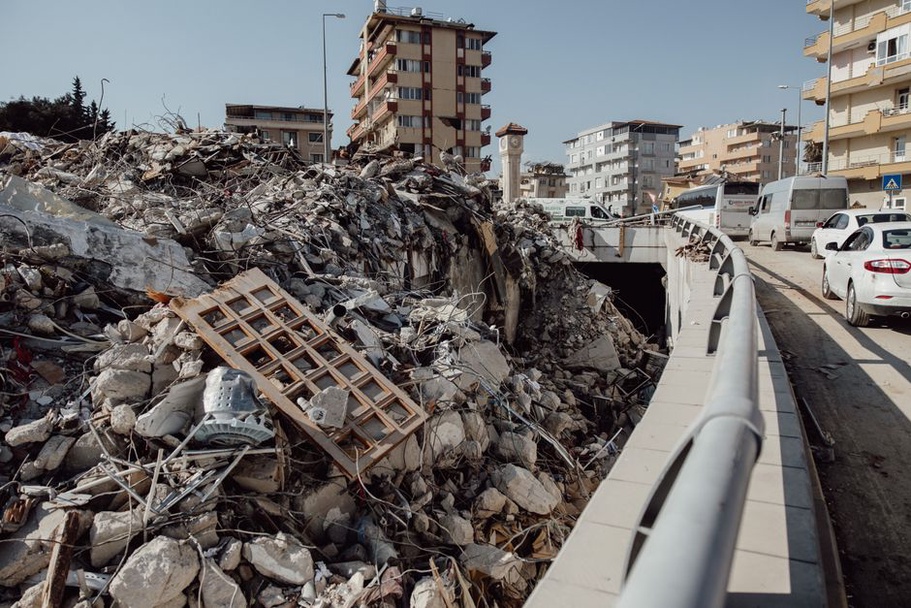
Design for inspection, triage, and repair access
Post-earthquake functionality depends in part on what can be checked quickly. Bridges benefit from visible bearing zones, accessible inspection routes, durable identification of critical components, and pre-established criteria for closure or restricted operation. Slopes and retaining structures benefit from reference markers, documented baseline conditions, and safe observation points for inspectors to assess cracks, bulging, blocked ditches, and rockfall.
Monitoring does not replace engineering inspection, but it can help prioritize field work. Strong-motion instruments, accelerometers, displacement sensors, pore-pressure measurements, inclinometers, and remote sensing may identify locations that experienced high demand or unusual movement. Monitoring systems should support clear decisions: which threshold triggers an inspection, who receives the alert, and what operational restriction follows.
Recovery planning should influence details
Repairability can improve through replaceable elements, standardized components, protected access for heavy equipment, and stockpiles or framework contracts for critical materials. This is particularly relevant to expansion joints, bearings, barrier segments, drainage components, and slope-protection materials. A repair plan that depends on equipment unable to reach the damaged location is not workable.
For tunnels and their approaches, earthquake performance includes portal slopes, lining joints, cross passages, ventilation equipment, power supply, and life-safety systems, rather than the underground lining alone. The relationship between ground deformation and tunnel response is examined in the analysis of seismic forces on tunnel structures.
Before opening a new or rehabilitated highway segment, the asset owner can carry out a focused seismic operability review. The review should identify likely closure mechanisms, assign inspection responsibility for each, confirm access routes and repair resources, and document criteria for safe reopening. A realistic exercise, such as settlement at one bridge approach combined with debris on an adjacent cut slope, can reveal gaps that calculations alone may miss.