
A single pavement reconstruction project can yield thousands of tonnes of asphalt-bound material. Its value is not determined by the word “recycled,” but by how well it is characterized, processed, protected from moisture, and matched to the demands of the pavement layer where it will be used.
Recycling preserves aggregate and, in many cases, residual binder that would otherwise be discarded. It may reduce hauling, quarry demand, and disposal volumes, but it also introduces a different set of engineering controls. Recovered materials are inherently variable. They may contain aged binder, adhered mortar, fines, salts, foreign debris, or excess moisture. Their use must be assessed against layer function, traffic loading, drainage, construction method, and verified material properties.
Material streams recovered during reconstruction
Pavement recycling produces several material streams, each with distinct behaviour and quality-control requirements.
Reclaimed asphalt pavement
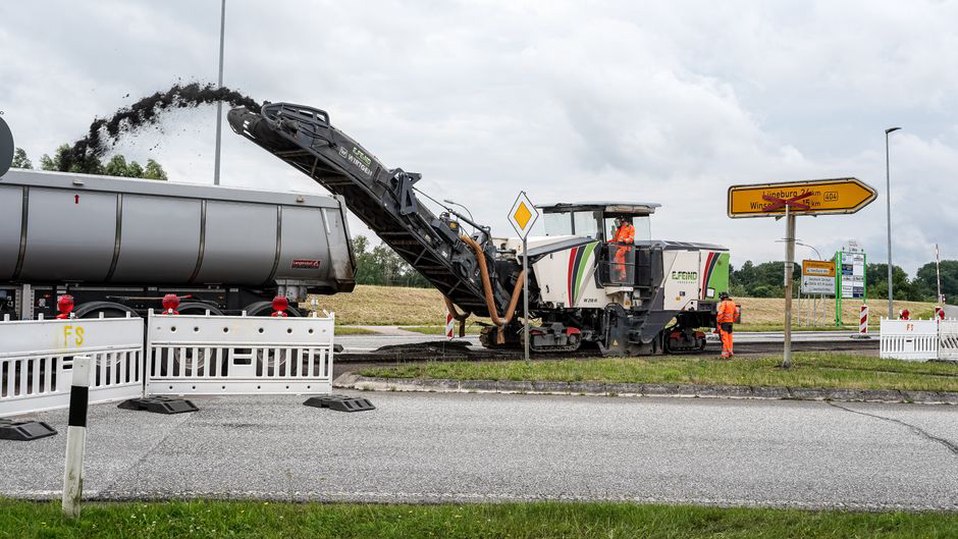
Reclaimed asphalt pavement (RAP) is produced by milling or removing existing asphalt layers. It consists of aggregate coated with aged bituminous binder. When properly processed, RAP can be incorporated into new hot-, warm-, or cold-mix asphalt, or used in bound and unbound pavement layers where project specifications allow.
The main engineering issue is binder aging. Recovered binder is usually stiffer than virgin binder. This can improve rutting resistance, but excessive stiffness or inadequate blending may reduce resistance to low-temperature cracking and fatigue. RAP is therefore more than a replacement for virgin aggregate. Mix design must consider recovered-binder content, gradation, the properties of the added binder, and the extent to which old and new binders interact during production.
Recycled concrete aggregate
Recycled concrete aggregate (RCA) is produced by crushing slabs, curbs, structural concrete, and other demolition concrete. It contains original aggregate together with adhered cement paste and mortar. Compared with natural aggregate, RCA often has higher water absorption, lower particle density, and a greater tendency toward particle breakdown. These characteristics affect water demand during compaction, achievable density, and stiffness.
RCA is often suitable for granular subbase, base, shoulders, drainage, or fill where its gradation, contamination level, durability, and chemical behaviour are compatible with the design. Residual cementitious material can cause limited hardening after placement. That may be beneficial or problematic, depending on the layer and drainage arrangement. It should not be assumed in design unless representative testing has established the effect.
Recycled granular material and mixed excavated pavement
Reconstruction work can also recover crushed granular base, gravel, sand, and mixed pavement debris. After screening and crushing, these materials may be useful, though their variability is often greater than that of RAP or processed RCA. Variable fines, clay contamination, organic matter, and uncontrolled blending with demolition waste can reduce bearing capacity and drainage performance.
Segregated excavation is one of the most important controls. Keeping asphalt, concrete, granular layers, and unsuitable soil separate during removal usually produces a more valuable recovered material stream than attempting to correct a mixed stockpile later.
Match recycled material to the layer function
Recycled material should be selected according to the function of the layer. Surface and binder courses must withstand traffic stresses and environmental aging. Base and subbase layers distribute wheel loads, retain shape, manage frost response where relevant, and protect the subgrade. Drainage layers need permeability and resistance to clogging. A material that performs adequately in one role may be unsuitable in another.
| Material | Typical potential applications | Key engineering checks |
|---|---|---|
| Processed RAP | New asphalt mixtures; cold recycled bound layers; selected granular applications | Binder content and condition, gradation, moisture, contaminants, mixture stiffness and cracking resistance |
| RCA | Subbase, base, shoulders, working platforms, selected drainage or fill layers | Gradation, absorption, abrasion resistance, compaction behavior, sulfate and other chemical risks |
| Recycled granular aggregate | Subbase, capping, fill, temporary works, stabilized layers | Fines content, plasticity, particle strength, permeability, frost susceptibility, moisture-density relationship |
| In-place recycled material | Cold or hot recycled pavement layers | Existing-layer variability, depth control, binder or stabilizer dosage, curing, achieved structural properties |
A common mistake is to classify recycled aggregate by nominal particle size alone. Gradation is important, but it does not prove structural adequacy. Fine content, plasticity, particle shape, absorption, abrasion resistance, moisture sensitivity, and resilient response can govern field performance. The same principle applies to RAP: milling gradation and binder percentage alone do not show that a new asphalt mixture will meet cracking, rutting, and durability requirements.
Processing determines consistency
Processing turns irregular demolition material into a controlled construction product. Depending on the feedstock and intended use, operations may include removal of reinforcing steel, scalping of oversized fragments, primary and secondary crushing, screening into defined fractions, blending, and removal of visible deleterious material.
Stockpile management
Stockpiles are part of production, not simply storage. RAP stockpiles should be managed to limit segregation, standing water, soil contamination, and uncontrolled mixing of material from different pavement sources. Excess moisture increases fuel demand during asphalt production and makes mixture consistency more difficult to control. Oversized chunks can also disrupt uniform feeding and cause erratic gradation.
For RCA and recycled granular aggregate, separating stockpiles by source and processing campaign supports traceability. Material placed directly on contaminated ground can pick up fines and organic matter before it reaches the paver. A prepared stockpile pad, drainage control, clear material identification, and controlled loading routes reduce this avoidable variation.
Source investigation before removal
Previous construction records, coring, test pits, and visual surveys can identify layer thicknesses, patching history, overlays, localized repairs, and possible contaminants. Sampling should represent the materials likely to be recovered, including different lanes, shoulders, structures, and repair areas. A few isolated samples from a visually uniform surface may miss major variation below it.
Potentially hazardous or unsuitable constituents need to be identified early and handled separately. Examples include coal tar-containing materials in some legacy pavements, asbestos-containing components, lead-bearing markings, petroleum-contaminated soils, and waste embedded in historic fills. Reuse decisions in these cases depend on applicable environmental requirements and qualified assessment. Crushing or blending does not resolve contamination.
Design and testing: from recovered feedstock to a reliable layer
Material qualification should address the performance risks of the project. Testing programmes generally combine physical characterization with mixture or layer performance assessment. Their scope and frequency should reflect source variability, traffic level, climatic exposure, and the consequences of early failure.
- For RAP: determine gradation, recovered asphalt binder content, moisture, and indicators of binder condition; evaluate the proposed asphalt mixture for workability, volumetric properties, moisture damage, rutting resistance, and cracking-related behaviour where appropriate.
- For RCA and recycled granular aggregate: assess particle-size distribution, fines and plasticity, water absorption, density, abrasion or fragmentation resistance, moisture-density response, bearing or stiffness indicators, and permeability where drainage is important.
- For stabilized recycled layers: verify stabilizer type and dosage, mixing uniformity, moisture condition, curing, strength development, shrinkage or cracking risk, and compatibility with the overlying pavement system.
- For all streams: inspect for deleterious materials and establish acceptance limits, sampling locations, lot definitions, and corrective actions before construction begins.
Laboratory results must be checked against field conditions. A granular layer may meet the specified gradation in the laboratory yet perform poorly if it is placed too wet, compacted unevenly, or exposed to pumping water from a weak subgrade. The relationship between material quality, compaction, and water is central to pavement reliability. Guidance on enhancing roadbed stability for safer transport infrastructure provides useful context for assessing that interaction beneath reconstructed layers.
Recycling approaches in pavement reconstruction
Projects generally choose between plant recycling, in which removed materials are hauled to a processing and mixing facility, and in-place recycling, in which part of the existing pavement is processed on the roadway. Both can be effective. The choice depends on pavement condition, geometry, logistics, target layer, traffic management, available equipment, and quality-control capability.
Plant-produced asphalt with RAP
In plant production, RAP is proportioned with virgin aggregate, new binder, and, where needed, additives or rejuvenating agents. The plant must heat and introduce RAP without excessive additional aging, smoke, or inconsistent moisture removal. As RAP content increases, RAP fractionation, feed-rate control, and confirmation of mixture performance become more important. Volumetric compliance alone is not enough.
Cold in-place recycling and full-depth reclamation
Cold in-place recycling processes part of the asphalt pavement, usually with emulsified asphalt, foamed bitumen, cement, or another approved binder system. Full-depth reclamation includes deeper pavement layers and may incorporate part of the underlying granular material. These methods can reduce hauling and rebuild a distressed structural layer quickly, but they demand careful control of milling depth, existing-material variability, binder dosage, moisture, compaction, and curing.
The recycled layer is usually part of a pavement system rather than the final riding surface. Its curing condition and protection from early moisture affect the timing and quality of the overlay. Cracking in a stabilized recycled layer can also reflect through the surfacing if layer configuration and construction sequencing are not considered.

Construction controls that protect long-term performance
Field quality assurance must assess the constructed layer as well as the delivered material. Moisture content, lift thickness, compaction coverage, density or stiffness, finished grade, and drainage continuity should be verified while correction remains practical. For asphalt mixtures containing RAP, plant records, temperature control, delivery consistency, laydown practices, and in-place density determine whether the designed mixture is actually achieved in the pavement.
Drainage requires particular attention when recycled aggregate is used. Higher fines content, fragile particles, or poorly controlled grading can reduce permeability over time. Water retained in a base or subbase can weaken the subgrade, promote freeze-thaw damage in cold regions, and cause pumping under repeated loading. Recycled material should not be given a drainage function simply because it appears coarse; permeability and filter compatibility must be assessed within the assembled pavement system.
Environmental value requires a whole-system check
Recycling can reduce virgin aggregate consumption and transportation demand, but the benefit is project-specific. Long hauls to a recycling plant, energy-intensive drying of wet RAP, additional crushing, stabilizer production, or premature repairs can alter the balance. A credible comparison considers material extraction, processing energy, transport distances, construction effects, service life, maintenance needs, and end-of-life pathways rather than counting diverted waste alone.
The broader framework for this comparison is discussed in Lifecycle Analysis in Transport Infrastructure: From Foundations to Decommissioning. For pavement reconstruction, the assumed service life is particularly important. A recycled solution that performs reliably over its intended design period may have a better environmental outcome than a nominally low-impact option that requires early intervention.
Common failure modes and preventable mistakes
- Uncontrolled source blending: Mixing RAP, concrete, soil, and demolition debris reduces the predictability of every resulting product.
- Using average test values alone: Averages can conceal a variable source. Acceptance should consider range, outliers, and the spatial distribution of poorer material.
- Ignoring water absorption of RCA: Incorrect water adjustments can prevent target compaction and alter stabilized-layer performance.
- Overlooking RAP moisture: Wet RAP affects plant energy demand, production stability, and mixture temperature control.
- Treating recycled aggregate as automatically free-draining: Fine particles, degradation, and migration of subgrade soil may substantially reduce drainage capacity.
- Reusing distressed material without diagnosing distress: Recycling does not remove the cause of failure if poor drainage, pumping, expansive soil, inadequate thickness, or weak support remains unresolved.
A practical acceptance plan makes these controls auditable. Define material lots by source and processing period, retain representative samples, record stockpile and moisture conditions, compare field measurements with approved target ranges, and isolate nonconforming loads before placement. For full-depth reclamation, records should also identify recycling depth, stabilizer application rate, mixing passes, compaction results, curing observations, and the location of every test segment.