
A road material is sustainable only if it performs reliably in the layer where it is placed. Recycled content alone is not enough: aggregate that breaks down under traffic, a binder unsuited to local temperature cycles, or fill that retains too much water can shorten service life and raise whole-life impacts. Material selection therefore needs to account for resource efficiency, pavement mechanics, drainage, constructability, and access for future maintenance.
What makes a road material sustainable?
A credible assessment follows the full chain of effects: extraction or recovery, processing energy, transport distance, construction emissions, in-service durability, maintenance demand, and end-of-life recovery. Comparisons should be functional rather than based on mass alone. Two pavement options need to be assessed against the same traffic loading, design period, safety requirements, and level of service.
Life-cycle assessment can quantify greenhouse-gas emissions, energy demand, water use, and resource depletion. These results need to be considered alongside engineering evidence. A material with low production emissions may require a thicker layer, intensive treatment, or more frequent repairs, reversing its apparent environmental benefit.
Performance comes before substitution rate
Roads are layered systems. Material suitable for embankment fill may be unsuitable for an unbound base. Likewise, reclaimed asphalt can be valuable in a surface or binder course only when gradation, aged-binder properties, and moisture condition are controlled. The first question is not how much conventional material can be replaced, but which functions the proposed material must fulfil: stiffness, fatigue resistance, rutting resistance, frost durability, filtration, drainage, or erosion control.
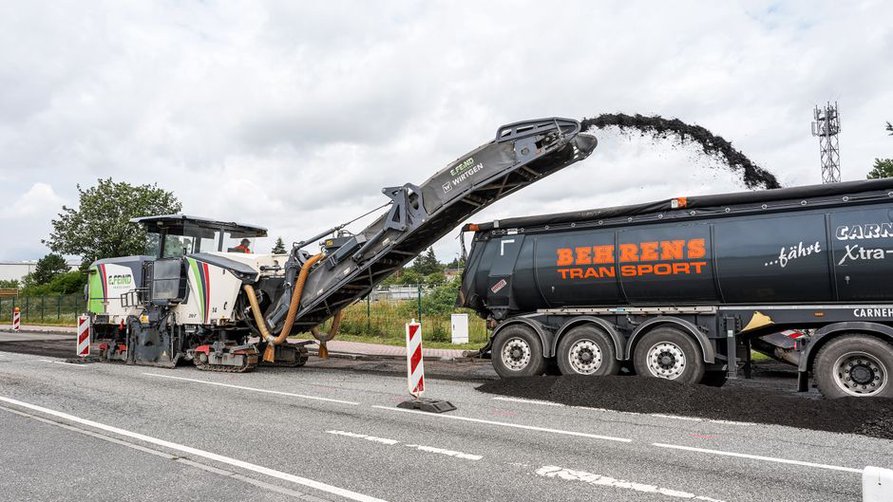
Recovered materials with established road applications
Reclaimed asphalt pavement
Reclaimed asphalt pavement (RAP) contains aggregate coated with aged bitumen. Used in new asphalt mixtures, it can reduce demand for virgin aggregate and binder, particularly when milling material is carefully segregated and processed. Its main engineering challenge is variability: gradation, binder content, contamination, and stiffness can differ substantially between stockpiles.
Higher RAP proportions usually call for closer control of aggregate blending, mixture volumetrics, plant temperature, and the interaction between virgin and aged binder. Rejuvenating agents or softer virgin binders may be appropriate, but suitability should be established through mixture-specific testing rather than assumed equivalence. Moisture control matters as well, since wet RAP increases heating energy and can disrupt production consistency.
Recycled concrete aggregate
Crushed concrete from demolition can be used in capping layers, subbases, and, where specifications and testing permit, selected base applications. It often has greater water absorption and more angular particles than natural aggregate. Residual cement paste can affect density, moisture sensitivity, and compaction behaviour. Source separation is essential: brick, wood, gypsum, metals, and harmful fines reduce consistency and may introduce durability or leachate concerns.
For unbound layers, laboratory and field verification should cover particle-size distribution, fines content, bearing capacity, abrasion resistance, frost susceptibility, and drainage behaviour. A material may meet strength requirements yet still contribute to seasonal weakening and deformation if it traps water.
Industrial by-products and secondary aggregates
Steel slag, blast-furnace slag, coal combustion residues, foundry sands, and glass-derived aggregate have been used in road works under controlled conditions. Suitability depends heavily on the source. Some slags provide strong, angular aggregate, while certain products may undergo volumetric instability through delayed hydration or oxidation. Ash-based materials can be useful in stabilized layers or fills, but their reaction characteristics and environmental acceptability must be confirmed for the specific source.
Testing may need to go beyond conventional strength indices. Relevant checks can include expansion, freeze-thaw resistance, chemical composition, leaching behaviour under applicable exposure conditions, and long-term drainage compatibility. Regulatory acceptance and local environmental requirements remain decisive.
Lower-carbon binders and asphalt technologies
Asphalt production requires substantial energy because aggregate must be heated and dried. Warm-mix asphalt technologies lower production and compaction temperatures through additives, foaming, or process modifications. This can reduce fuel use and plant emissions while improving workability in cool conditions. Moisture susceptibility, achieved density, and early-life performance still require verification.
In cement-bound layers, supplementary cementitious materials and alternative binder systems may reduce clinker demand. Their use depends on curing conditions, available chemistry, strength development, sulfate exposure, and compatibility with local aggregates and construction sequencing. Slower early strength gain may be acceptable in some applications but can be problematic where construction traffic must use the layer soon after placement.
| Material option | Typical road role | Key engineering control |
|---|---|---|
| RAP | Asphalt surface, binder, or base mixtures | Binder stiffness, gradation, moisture, and mixture design |
| Recycled concrete aggregate | Fill, subbase, selected base layers | Absorption, contamination, compaction, and frost behavior |
| Slag aggregate | Unbound layers or asphalt aggregate | Volumetric stability and environmental characterization |
| Warm-mix asphalt | Asphalt courses | Compaction, moisture resistance, and plant quality control |
| Stabilized local soil | Improved subgrade or capping layer | Soil variability, curing, drainage, and durability |
Using local soils without transferring risk
Hauling high-quality aggregate over long distances can dominate both impacts and cost. Where local soils are unsuitable in their natural state, mechanical improvement or stabilization may reduce the need for imported material and disposal. Lime, cement, hydraulic binders, and other treatments can improve workability and bearing capacity, but treatment is not a universal answer. Organic soils, sulfate-bearing soils, highly variable glacial deposits, and excessively wet materials may need further investigation or another approach.
The design basis should include representative samples from cuts, fills, and borrow areas. Laboratory results should then be checked against trial sections, as field performance is strongly affected by mixing uniformity, water addition, pulverization, curing, and weather exposure. Even a well-designed subgrade treatment can perform poorly if side drainage and surface-water control are neglected.
Design and procurement controls
Sustainable material specifications should set functional acceptance criteria rather than relying solely on prescriptive source restrictions. This allows the use of qualified secondary materials without weakening durability requirements. Performance-based wording must, however, be backed by realistic inspection arrangements, sampling frequency, traceability, and clear responsibility for nonconforming loads.
- Characterize feedstock sources before approval and keep stockpiles segregated.
- Set limits for contaminants, harmful particles, moisture, and particle-size distribution.
- Use trial mixes or trial sections where material variability or unfamiliar binders introduce uncertainty.
- Confirm compaction, layer thickness, stiffness, and drainage during construction.
- Record material origin, test results, placement location, and mixture proportions to inform future maintenance decisions.
Construction quality is especially important when recycled aggregates are placed in lower layers, because defects may remain hidden until rutting, pumping, or moisture-related distress reaches the surface. The same emphasis on drainage control, targeted inspection, and maintenance planning appears in Bridge Foundation Innovation: Ground Models, Monitoring and Verification, although pavement layers and bridge foundations serve different structural functions.
Common limitations and misleading claims
“Local” does not automatically mean low impact if processing involves repeated hauling, drying, or treatment. “Recycled” does not necessarily mean circular if the material can only be downcycled once and cannot be recovered again. A lower-carbon binder is not inherently more durable in every climate or traffic condition. Decisions should reflect local availability, haul routes, plant capability, weather windows, traffic loading, and expected maintenance interventions.
A practical verification plan can begin with a defined pavement section. Record virgin-material baseline quantities, source-to-site haul distances, proposed recycled or local content, plant energy data where available, and acceptance test results. After construction, retain cores, density records, and early condition observations against the relevant chainage and material batch. Those records give the next specification revision an evidence base rather than leaving it dependent on nominal recycled-content claims.