
Damage in transport infrastructure often begins before it can be seen. It may develop within pores, at aggregate interfaces, around reinforcing fibers, or along the bond between an asphalt layer and its substrate. Water, oxygen, chlorides, freeze–thaw cycles, repeated axle loads, temperature gradients, and construction variability act on these features long before rutting, cracking, corrosion staining, or settlement appears. Materials science links those early mechanisms to the service performance expected of roads, railways, bridges, tunnels, and earthworks.
Material selection is therefore not simply a choice of the strongest product on a datasheet. It involves matching a material system to loading, climate, exposure, geometry, constructability, inspection access, maintenance strategy, and the uncertainty of field conditions. High compressive strength alone, for example, does not guarantee a durable concrete deck in a chloride environment or a dependable stabilized subgrade exposed to seasonal moisture changes.
Performance begins with material systems
Infrastructure components rarely perform as isolated materials. An asphalt pavement is a layered system of binder, aggregate skeleton, air voids, interfaces, base course, subgrade, and drainage. Reinforced concrete combines a cementitious matrix, aggregates, steel or alternative reinforcement, cover depth, joints, and curing quality. Ballasted rail track relies on ballast abrasion and breakage resistance, geotextile filtration where used, formation stiffness, water management, and the repeated stresses imposed by trains.
This systems view changes how performance should be assessed. A material may satisfy laboratory acceptance criteria yet perform poorly in service because an interface was contaminated, compaction varied, drainage was restricted, or local restraint caused cracking. Conversely, a material with moderate nominal strength may provide long service where it has suitable toughness, permeability control, fatigue resistance, and compatibility with adjacent layers.
Key properties and why they matter
- Stiffness governs deformation under load, although excessive stiffness can increase susceptibility to cracking where thermal movement or differential settlement is significant.
- Strength indicates resistance to crushing, tension, shear, or bearing failure, depending on the component and load path.
- Toughness and fracture resistance describe the ability to absorb energy and limit unstable crack growth.
- Fatigue resistance governs response to millions of stress cycles that remain below short-term strength.
- Permeability and sorptivity affect the entry and movement of water and dissolved salts.
- Thermal expansion, shrinkage, and creep determine strains that develop without traffic loading.
- Chemical stability is important in soils containing sulfates, saline water, de-icing salts, industrial contaminants, or aggressive groundwater.
Road and rail materials under repeated loading
Road surfacing materials must withstand contact stress, shear, bending, thermal cycling, oxidation, and moisture. In asphalt mixtures, the binder must retain cohesion and adhesion to aggregate while aggregate gradation provides a stable internal skeleton. Binder aging can increase stiffness and improve resistance to some high-temperature deformation modes, but it can also reduce stress-relaxation capacity and increase the likelihood of low-temperature or fatigue cracking. Moisture damage becomes more likely when water weakens the binder–aggregate bond or pore pressure develops under traffic.
Aggregate is not inert merely because it is mineral. Shape, surface texture, mineralogy, absorption, polishing resistance, and susceptibility to fragmentation affect workability, skid resistance, moisture sensitivity, and long-term mixture structure. Stockpile management and clean handling matter because fine contamination or segregation can alter the effective gradation supplied to the plant.
In railways, ballast must transfer loads, provide drainage, maintain geometry, and tolerate abrasion and particle breakage. Progressive fouling reduces void space and drainage capacity, increasing moisture retention and changing track support. Fine particles may result from ballast degradation, subgrade pumping, external contamination, or inadequate separation between layers. This is both a material and geotechnical problem: changes in particle-size distribution alter hydraulic behavior and stress transfer.
Material condition should be interpreted alongside track geometry, moisture, formation response, and maintenance history. The relationship between sensor evidence and maintenance choices is examined in Rail Track Monitoring: Sensors, Data and Maintenance Decisions.
Concrete durability is controlled by transport processes
Concrete compressive strength is useful, but it is an incomplete indicator of durability. Most long-term deterioration mechanisms depend on how readily water, gases, and ions enter and move through the pore network. Mixture proportions, supplementary cementitious materials, placement, consolidation, curing, cracking, and cover all affect that network.
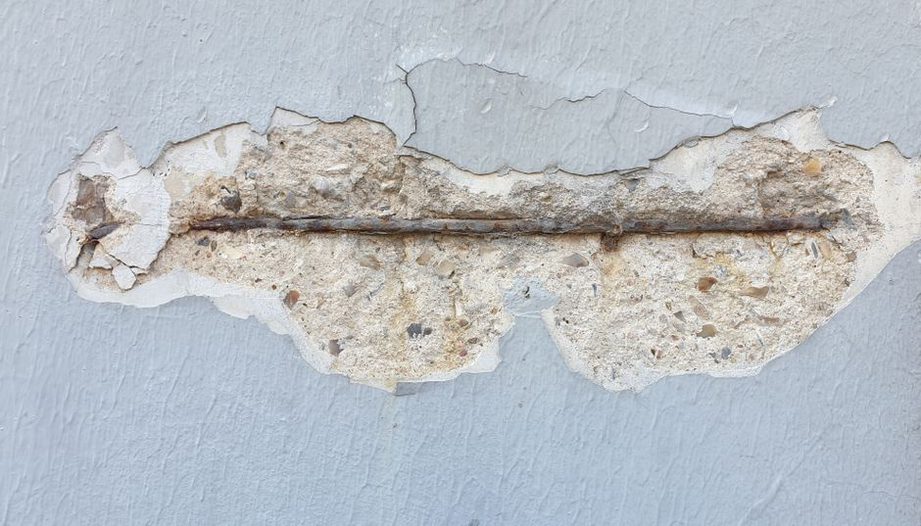
For reinforced concrete exposed to chlorides, the central issue is whether chloride ingress and moisture conditions can initiate reinforcement corrosion. Corrosion products occupy more volume than the original steel, generating tensile stresses that crack and delaminate the cover concrete. Freeze–thaw exposure can also be severe when concrete becomes critically saturated. Where conditions warrant it, properly entrained air systems, suitable aggregate, and controlled permeability are important parts of the resistance strategy.
Compatibility at repairs and interfaces
Repair materials need more than high early strength. A rigid repair patch bonded to older, more compliant concrete can concentrate stress at the interface. Differential shrinkage, elastic modulus, thermal movement, moisture exchange, and permeability can all affect repair durability. Similar concerns arise at joints, overlays, waterproofing membranes, and corrosion-protection systems.
Laboratory bond testing is useful, but it does not replace field verification of surface preparation, substrate moisture condition, reinforcement condition, placement temperature, curing, and drainage details. Materials should be assessed as part of the proposed repair assembly and its expected exposure, rather than as independent products.
| Infrastructure component | Dominant material concerns | Useful evidence |
|---|---|---|
| Asphalt pavement | Binder aging, moisture sensitivity, permanent deformation, fatigue | Mixture volumetrics, cores, layer thickness, drainage observations, distress mapping |
| Concrete bridge element | Chloride ingress, cracking, carbonation, freeze–thaw damage, alkali-related reactions | Cover survey, crack map, sampling, corrosion indicators, moisture exposure review |
| Rail ballast and formation | Breakdown, fouling, abrasion, pumping, loss of drainage | Particle grading, fouling assessment, track geometry, moisture and formation investigation |
| Tunnel lining | Water ingress, sulfate attack, leaching, cracking, reinforcement corrosion | Leak mapping, material sampling, crack monitoring, groundwater chemistry where relevant |
Metals, composites, and protective systems
Steel remains essential because of its strength, ductility, fabrication options, and predictable structural behavior. Its durability, however, depends heavily on corrosion control. Coatings, galvanizing, weathering behavior under suitable exposure conditions, drainage, crevice avoidance, inspection access, and connection detailing all influence corrosion risk. Local coating damage is not always critical, but it should be judged against the environment, cathodic effects, water retention, and the ability to inspect and repair the affected area.
Fiber-reinforced polymer composites can provide corrosion resistance and low mass, but their behavior is anisotropic: strength and stiffness depend on fiber direction, fiber volume, resin system, connection design, and manufacturing quality. Long-term concerns include ultraviolet exposure, moisture uptake, resin degradation, creep, temperature sensitivity, fire performance, and hidden delamination after impact. Their reliable use depends on a clearly defined load path and inspection methods capable of identifying defects that may not be visible at the surface.
Protective materials—membranes, sealers, joint systems, coatings, and cathodic protection components—require the same scrutiny as structural materials. Their service life may govern the condition of the element they protect. A waterproofing system that loses adhesion near a joint, for example, can expose a bridge deck to water and salts despite otherwise sound concrete.
Low-carbon materials require performance verification
Lower-emission binders, recycled aggregates, reclaimed asphalt materials, industrial by-products, and optimized mixture designs can reduce embodied impacts, but sustainability claims still need to be tested against service conditions. Recycled materials may show greater variability in grading, contamination risk, absorption, or residual binder properties. Alternative binders may develop strength, shrinkage, permeability, and chemical resistance differently from conventional systems.
The key question is not whether a material is “green,” but whether verified performance supports the required design life, maintenance approach, and exposure class. A longer-lasting material with higher initial impacts may be preferable to a lower-impact option that requires frequent intervention, particularly where closures carry major operational and safety consequences. Lifecycle assessment is most useful when it includes realistic assumptions for maintenance, renewal, transport, and end-of-life treatment rather than only initial material quantities.
From laboratory results to field confidence
Material characterization should begin with the service environment, move to the relevant failure mechanisms, and then select tests that represent those mechanisms. Generic acceptance testing remains necessary, but it may not identify the property governing an asset’s actual risk. Compressive strength, for example, does not directly characterize chloride transport, and a short-term tensile test does not fully describe crack growth over decades of cyclic loading.
- Define exposure and demand. Establish loading spectra, temperature range, wetting and drying conditions, chemical exposure, construction constraints, and inspection access.
- Identify credible degradation mechanisms. These may include fatigue, abrasion, corrosion, sulfate attack, freeze–thaw damage, moisture-induced stripping, creep, or interface debonding.
- Select representative tests and acceptance criteria. Test methods should suit the material, expected failure mode, and stage of decision-making.
- Control production and installation. Verify source materials, batching, temperature, compaction or consolidation, curing, layer thickness, and interface preparation.
- Establish baseline condition data. Construction records support later diagnosis when distress develops.
Field verification is particularly important because transport assets extend over long alignments and are built in variable weather. Core extraction, thickness checks, density measurements, non-destructive testing, petrographic examination, chemical analysis, and targeted excavation answer different questions. No single test should be treated as conclusive without considering sampling location, uncertainty, and the relationship between the observed condition and its structural significance.
Where natural hazards are relevant to a project, the material model must also account for extreme deformation and damage tolerance. Reinforcement ductility, confinement, connection behavior, soil–structure interaction, and post-event inspectability may matter more than nominal static strength. The mechanisms used to evaluate such exposure are addressed in Understanding Seismic Vulnerabilities in Transport Infrastructure.
Specifying for reliability rather than catalogue values
A sound specification defines required performance, allowable variability, verification methods, documentation, and actions when results fall outside expectations. It should also avoid conflicting requirements—for example, demanding low water content, extended workability, rapid strength gain, low shrinkage, and unusually high durability without assessing whether the selected material system can meet all of them under site conditions.
For repair or rehabilitation work, map every interface: substrate-to-repair, membrane-to-concrete, coating-to-steel, ballast-to-separation layer, or asphalt lift-to-tack coat. Record the surface condition, preparation method, moisture and temperature limits, inspection hold point, and consequence of failure at each one. This simple interface register can reveal risks that bulk material certificates will not show.